When ever we have stimulus coming to us (it can be behaviours, an action, words people say to us, problem occurs etc), we have FREEDOM TO CHOOSE our responses. However, more often than not, we tend to choose the response that we will regret later. How can we overcome this?
I would like to share with all of you readers today, (compliments of Stephen R. Covey), what are our Four Human Gifts that if we hold on to it, we will always be the proactive people, who will choose the appropriate response first time, every time.
The four human gifts are:
1. Self Awareness
- examine our thinking & motives
2. Imagination
- ability to create in our minds beyond present reality
3. Conscience
- internal guiding system
- allow us to sense when acting with or against principles
4. Independet Will
- capacity to act freely based on our own self awareness
- free from other influences
I leave you to reflect on this gifts, and where@how@why have we lost them, because as a child before, we are a different human being - we are what we are. As an adult? Share your thoughts with us here at Pourtavie!
(the below are examples of how as a child before, we use our four gifts in creative ways...)
Kids Think Quick
TEACHER : Maria, go to the map and find North America
MARIA : Here it is!
TEACHER : Correct. Now class, who discovered America ?
CLASS : Maria!
TEACHER : Why are you late, Frank?
FRANK : Because of the sign.
TEACHER : What sign?
FRANK : The one that says, "School Ahead, Go Slow."
TEACHER : John, why are you doing your math multiplication on the floor?
JOHN : You told me to do it without using tables!
TEACHER : Glenn, how do you spell "crocodile?"
GLENN : K-R-O-K-O-D- A-I-L"
TEACHER : No, that's wrong
GLENN : Maybe it s wrong, but you asked me how I spell it!
TEACHER : Donald, what is the chemical formula for water?
DONALD : H I J K L M N O!!
TEACHER : What are you talking about?
DONALD : Yesterday you said it's H to O!
TEACHER : Winnie, name one important thing we have today that we
didn't have ten years ago.
WINNIE : Me!
TEACHER : Millie, give me a sentence starting with "I."
MILLIE : I is...
TEACHER : No, Millie..... Always say, "I am."
MILLIE : All right... "I am the ninth letter of the alphabet."
TEACHER : Can anybody give an example of COINCIDENCE?
TINO : Sir, my Mother and Father got married on the same day, same time."
TEACHER : George Washington not only chopped down his father's cherry
tree, but also admitted doing it. Now, Louie, do you why his father didn't punish him?"
LOUIS : Because George still had the ax in his hand.
TEACHER : Clyde , your composition on "My Dog" is exactly the same
as your brother's. Did you copy his?
CLYDE : No, teacher, it's the same dog!;
TEACHER : Harold, what do you call a person who keeps on talking
when people are no longer interested?
HAROLD : A teacher.
Friday, March 16, 2007


Tuesday, March 06, 2007
Dining Etiquette For The Fast-food Generation
Everyone needs an etiquette book on his or her shelf, one of those five-pound encyclopedias of everything related to manners. I think it should be a mandatory gift to every graduate, right along with the PDA and new briefcase. I received one when I finished high school and I still have it on my bookshelf. It's a little dog-eared, but the advice within isn't showing its age (unlike its owner).
Why is this book so important? You'll be glad you have it when you're faced with an invitation to a formal event. It will teach you first how to properly respond to the invitation and then, how to eat that multi-course meal with dozens of utensils, plates and glasses. It can help you plan a wedding, teach you how to write a letter, even how to get along with your co-workers.
But in this fast-food era, many people have forgotten - or were never taught - the fundamentals of dining etiquette. Which way should I pass? Which fork is mine? What do I do with my napkin? What follows are the answers to the basic questions many people have about dining. (If you need advice on how to combine business with a meal, please read "The Business Lunch" posted in the "Image Insights" archives.)
The first thing to do after being seated at a table is to immediately place your napkin in your lap. Unfold it into either a large triangle or rectangle. Never use your napkin as a tissue, but have one close by if you think you'll need to wipe your nose during the meal. Ladies should blot their lipstick with a tissue before eating so that they don't soil the cloth napkin and glassware. Don't flip over your coffee cup or other glassware you won't be using. If a beverage is served during the meal that you don't want, simply hold your hand over the cup and say, "No thank you."
If you have to leave the table during the meal, say a soft "excuse me" to the people on either side of you, leave your napkin on your chair (not the table) and push the chair under the table as you leave.
As you look at your place setting, remember that solids are on the left and liquids are on the right. In other words, your bread plate is on the left side above your forks and your drinking glasses are on the right side above the knife and spoons. Use silverware from the outside in. The first fork you will need will probably be your salad fork, the one farthest on the left. The larger fork directly to its right is your dinner fork. On the far right side of your place setting will most likely be a soup spoon, and on its left, a teaspoon followed by the knife. If you see utensils placed horizontally across the top of your place setting, save those for dessert. Remember - once a utensil has been used for eating, it never again touches the tablecloth, only the china!

Your "real estate" at a table consists of, not only your place setting, but also the other items directly in front of you. It is your responsibility to take notice of those things and initiate their use. Roll baskets, butter, cream, salad dressings, sugar, salt and pepper - if they're within your reach, pick them up and start them around. Pass to the right and refrain from helping yourself first. Those items should make a complete pass around the table before you get your turn. If you just can't stand not having first choice of the rolls, turn to your neighbor on your right and say, "Would you mind if I help myself first?" They'll always say yes. Whenever you pass something with a handle, such as dressings, pass it with the handle facing the other person so that they can grasp it easily. And always pass the salt and pepper as a set, even if only one was requested.
It's important that you place the butter first on the bread plate before buttering your bread. Break up your bread or rolls into one- or two-bite morsels for buttering and eating. Whatever you take up to your mouth to eat should be eaten in one or two consecutive bites. Your tablemates don't want to see the part that didn't quite fit in your mouth placed back on your bread plate!
To eat soup properly, draw the spoon away from you and quietly sip the soup from the side of the spoon. Tilt the bowl away from you to get to the last drops. When you're finished, place the spoon on the plate beneath the soup bowl. If there is no plate, rest the spoon in the bowl. Follow these same guidelines for any dessert served in a bowl.
Salads should be prepared so that they consist of bite-size pieces. But if the salad contains leaves that are too big to eat, use your salad fork to cut them into smaller pieces. And if that doesn't work, use your dinner knife. But only use the knife when all other methods have failed. Why? Because you'll also need that knife for the main course, and after you've used it for the salad, there's no place to put it so that it doesn't also disappear with the salad plate.
When eating the main course, pace your speed of eating to that of your tablemates so that you don't make them feel uncomfortable. In the United States, we eat "American Style". Here's how to do it. Cut your food with the fork in your left hand and the knife in your right hand. Cut only one piece at a time. Then lay your knife down along the top edge of the plate and transfer the fork to your right hand. Bring the food up to your mouth with the tines on the fork facing upward. Don't stab your food or hold the silverware with your fists. And be careful not to gesture or point with your silverware, whether or not it has food on it.
If you must remove something from your mouth as you eat, take it out the way it went in. In other words, if it entered your mouth on a fork, remove it with your fork. If it was finger food, use your fingers to remove it. Hold your napkin in front of your mouth to mask the removal, then place the item on the side of your plate. Don't try to hide it under the plate, because as soon as the plates are cleared it will be left behind on the tablecloth! Don't hide any paper trash you've accumulated during the meal under your plate either. Just place it on the edge of your bread plate.
At the conclusion of the meal, imagine your dinner plate as a clock and place your utensils in the 4:20 position. It's considered rude to push your plates away, stack them up or hand them to the server. Place your loosely-folded napkin on the table just as you stand to leave, not before.
Maneuvering through a meal doesn't have to be scary. Like all elements of etiquette, it boils down to common sense combined with kindness. Knowing the guidelines for dining etiquette gives you confidence so that you can relax and enjoy the meal and company. And in this fast-food age, it can also make you unforgettable!
Jill Bremer, AICI, CIP, owner of Bremer Communications, offers training, consulting and coaching in professional image development and presentation skills. Her clients include Oracle, Abbott Labs, W.W. Grainger, U.S. Department of Energy and the National Association of Realtors. She can be reached at 708-848-5945 or at www.bremercommunications.com
Why is this book so important? You'll be glad you have it when you're faced with an invitation to a formal event. It will teach you first how to properly respond to the invitation and then, how to eat that multi-course meal with dozens of utensils, plates and glasses. It can help you plan a wedding, teach you how to write a letter, even how to get along with your co-workers.
But in this fast-food era, many people have forgotten - or were never taught - the fundamentals of dining etiquette. Which way should I pass? Which fork is mine? What do I do with my napkin? What follows are the answers to the basic questions many people have about dining. (If you need advice on how to combine business with a meal, please read "The Business Lunch" posted in the "Image Insights" archives.)
The first thing to do after being seated at a table is to immediately place your napkin in your lap. Unfold it into either a large triangle or rectangle. Never use your napkin as a tissue, but have one close by if you think you'll need to wipe your nose during the meal. Ladies should blot their lipstick with a tissue before eating so that they don't soil the cloth napkin and glassware. Don't flip over your coffee cup or other glassware you won't be using. If a beverage is served during the meal that you don't want, simply hold your hand over the cup and say, "No thank you."
If you have to leave the table during the meal, say a soft "excuse me" to the people on either side of you, leave your napkin on your chair (not the table) and push the chair under the table as you leave.
As you look at your place setting, remember that solids are on the left and liquids are on the right. In other words, your bread plate is on the left side above your forks and your drinking glasses are on the right side above the knife and spoons. Use silverware from the outside in. The first fork you will need will probably be your salad fork, the one farthest on the left. The larger fork directly to its right is your dinner fork. On the far right side of your place setting will most likely be a soup spoon, and on its left, a teaspoon followed by the knife. If you see utensils placed horizontally across the top of your place setting, save those for dessert. Remember - once a utensil has been used for eating, it never again touches the tablecloth, only the china!

Your "real estate" at a table consists of, not only your place setting, but also the other items directly in front of you. It is your responsibility to take notice of those things and initiate their use. Roll baskets, butter, cream, salad dressings, sugar, salt and pepper - if they're within your reach, pick them up and start them around. Pass to the right and refrain from helping yourself first. Those items should make a complete pass around the table before you get your turn. If you just can't stand not having first choice of the rolls, turn to your neighbor on your right and say, "Would you mind if I help myself first?" They'll always say yes. Whenever you pass something with a handle, such as dressings, pass it with the handle facing the other person so that they can grasp it easily. And always pass the salt and pepper as a set, even if only one was requested.
It's important that you place the butter first on the bread plate before buttering your bread. Break up your bread or rolls into one- or two-bite morsels for buttering and eating. Whatever you take up to your mouth to eat should be eaten in one or two consecutive bites. Your tablemates don't want to see the part that didn't quite fit in your mouth placed back on your bread plate!
To eat soup properly, draw the spoon away from you and quietly sip the soup from the side of the spoon. Tilt the bowl away from you to get to the last drops. When you're finished, place the spoon on the plate beneath the soup bowl. If there is no plate, rest the spoon in the bowl. Follow these same guidelines for any dessert served in a bowl.
Salads should be prepared so that they consist of bite-size pieces. But if the salad contains leaves that are too big to eat, use your salad fork to cut them into smaller pieces. And if that doesn't work, use your dinner knife. But only use the knife when all other methods have failed. Why? Because you'll also need that knife for the main course, and after you've used it for the salad, there's no place to put it so that it doesn't also disappear with the salad plate.
When eating the main course, pace your speed of eating to that of your tablemates so that you don't make them feel uncomfortable. In the United States, we eat "American Style". Here's how to do it. Cut your food with the fork in your left hand and the knife in your right hand. Cut only one piece at a time. Then lay your knife down along the top edge of the plate and transfer the fork to your right hand. Bring the food up to your mouth with the tines on the fork facing upward. Don't stab your food or hold the silverware with your fists. And be careful not to gesture or point with your silverware, whether or not it has food on it.
If you must remove something from your mouth as you eat, take it out the way it went in. In other words, if it entered your mouth on a fork, remove it with your fork. If it was finger food, use your fingers to remove it. Hold your napkin in front of your mouth to mask the removal, then place the item on the side of your plate. Don't try to hide it under the plate, because as soon as the plates are cleared it will be left behind on the tablecloth! Don't hide any paper trash you've accumulated during the meal under your plate either. Just place it on the edge of your bread plate.
At the conclusion of the meal, imagine your dinner plate as a clock and place your utensils in the 4:20 position. It's considered rude to push your plates away, stack them up or hand them to the server. Place your loosely-folded napkin on the table just as you stand to leave, not before.
Maneuvering through a meal doesn't have to be scary. Like all elements of etiquette, it boils down to common sense combined with kindness. Knowing the guidelines for dining etiquette gives you confidence so that you can relax and enjoy the meal and company. And in this fast-food age, it can also make you unforgettable!
Jill Bremer, AICI, CIP, owner of Bremer Communications, offers training, consulting and coaching in professional image development and presentation skills. Her clients include Oracle, Abbott Labs, W.W. Grainger, U.S. Department of Energy and the National Association of Realtors. She can be reached at 708-848-5945 or at www.bremercommunications.com
Copyright © 2004 Bremer Communications All Rights Reserved
Wednesday, February 21, 2007
Energy Vampires
Some people bring unexpected lightness and comfort to your life. They crackle with energy, practically electrify you with their presence. And then there are those who leave you feeling stressed out. Or guilty. Or exhausted down to your very last molecule. I call them energy vampires, and obnoxious or meek, they come in all forms. The sob sister, for one, always considers herself the victim. The world is always against her, and she'll recount every horrible thing that has happened to her, wallowing in every perceived slight. The charmer is a constant talker or joke-teller who has to be the center of attention. The blamer, on the other hand, doles out endless servings of guilt. And then there's the drama queen, the co-worker who claims she almost died from a high fever or the neighbor who lives in extremes of emotion—life is unbelievably good or horrifically bad.
No matter which type of energy vampire you're dealing with, you're allowed to walk away. Many of us find this really hard to do. We're afraid of being thought of as impolite; we don't want to offend people. But there are plenty of ways to remove yourself from a killing conversation. When leaving isn't an option, you can still maintain your energy level by making a few minor adjustments.
Recognize the Signs
One of the first things to do is to recognize when you're being drained, and that begins with tuning in to your physical reactions. Is there a tightening in your chest when a certain person enters the conversation? Do you feel tired when you hang up the phone after speaking with someone? Does your head ache, or do you feel what I call "slimed" when another guest at a cocktail party starts talking to you?
Take a Deep Breath
The moment you feel zapped—or hemmed in, or stressed out—I recommend taking a breath. Breathing is a wonderful way to center yourself. Just follow the breath and tell yourself that you know what's happening and you can deal with it. It's important to remember our individual power. I know from working with patients that we can lose it easily. The minute somebody comes in who's bossy or blaming, we feel diminished and tense up. If we can focus on the breath, or on an image of a striking sunset or a view from a mountaintop, the tension will drift away.
Use Your Energy
You can also use some of your own subtle energy to counter the effects of an energy vampire. Visualize a protective white light around you: an energy shield. You can still hear the person who's yelling at you or blaming you or pushing herself into your sphere, but she won't cut into you so viscerally anymore. You've created a buffer zone, where her negative influences can dissipate.
Set Boundaries
Setting boundaries is another way of protecting yourself; you draw a line saying, for instance, "This is what I can do for you, and this is what I can't." You don't have to convince the vampire of the rightness of your stance. Getting defensive simply adds to the negative charge of the encounter. You want to remain neutral. When someone starts pushing your buttons, and you start sizzling inside, you've got to make the decision not to react.
Step Back
I also suggest you step back and think about what type of people aggravate you, because I believe that one law of energy is that we attract what we haven't yet worked out in ourselves. If I'm a very angry person, I'll find myself surrounded by angry people. By paying attention to the people who seem so draining, you might discover something you need to address. It has been my experience that once you've worked through a particular issue, you're no longer worn out by that kind of energy vampire. And the vampires, robbed of a source, move on to more easily drainable audiences.
by Judith Orloff, M.D.
Some people bring unexpected lightness and comfort to your life. They crackle with energy, practically electrify you with their presence. And then there are those who leave you feeling stressed out. Or guilty. Or exhausted down to your very last molecule. I call them energy vampires, and obnoxious or meek, they come in all forms. The sob sister, for one, always considers herself the victim. The world is always against her, and she'll recount every horrible thing that has happened to her, wallowing in every perceived slight. The charmer is a constant talker or joke-teller who has to be the center of attention. The blamer, on the other hand, doles out endless servings of guilt. And then there's the drama queen, the co-worker who claims she almost died from a high fever or the neighbor who lives in extremes of emotion—life is unbelievably good or horrifically bad.
No matter which type of energy vampire you're dealing with, you're allowed to walk away. Many of us find this really hard to do. We're afraid of being thought of as impolite; we don't want to offend people. But there are plenty of ways to remove yourself from a killing conversation. When leaving isn't an option, you can still maintain your energy level by making a few minor adjustments.
Recognize the Signs
One of the first things to do is to recognize when you're being drained, and that begins with tuning in to your physical reactions. Is there a tightening in your chest when a certain person enters the conversation? Do you feel tired when you hang up the phone after speaking with someone? Does your head ache, or do you feel what I call "slimed" when another guest at a cocktail party starts talking to you?
Take a Deep Breath
The moment you feel zapped—or hemmed in, or stressed out—I recommend taking a breath. Breathing is a wonderful way to center yourself. Just follow the breath and tell yourself that you know what's happening and you can deal with it. It's important to remember our individual power. I know from working with patients that we can lose it easily. The minute somebody comes in who's bossy or blaming, we feel diminished and tense up. If we can focus on the breath, or on an image of a striking sunset or a view from a mountaintop, the tension will drift away.
Use Your Energy
You can also use some of your own subtle energy to counter the effects of an energy vampire. Visualize a protective white light around you: an energy shield. You can still hear the person who's yelling at you or blaming you or pushing herself into your sphere, but she won't cut into you so viscerally anymore. You've created a buffer zone, where her negative influences can dissipate.
Set Boundaries
Setting boundaries is another way of protecting yourself; you draw a line saying, for instance, "This is what I can do for you, and this is what I can't." You don't have to convince the vampire of the rightness of your stance. Getting defensive simply adds to the negative charge of the encounter. You want to remain neutral. When someone starts pushing your buttons, and you start sizzling inside, you've got to make the decision not to react.
Step Back
I also suggest you step back and think about what type of people aggravate you, because I believe that one law of energy is that we attract what we haven't yet worked out in ourselves. If I'm a very angry person, I'll find myself surrounded by angry people. By paying attention to the people who seem so draining, you might discover something you need to address. It has been my experience that once you've worked through a particular issue, you're no longer worn out by that kind of energy vampire. And the vampires, robbed of a source, move on to more easily drainable audiences.
by Judith Orloff, M.D.
Sunday, February 18, 2007
xin nian kuai le

on behalf of all the angels, may i wish you all the best of happiness and health.
kuE's note: more pics of the above can be viewed here ;)
kuE's note: more pics of the above can be viewed here ;)
Wednesday, February 14, 2007
Let's Celebrate Love!
I owe this to La Pour Ta Vie Community….
Since I have been very quiet these past few weeks, I feel that I have to share this with all of you in conjunction with the Day of Love……
(I got this from a friend)
The Meaning of Flowers..
BABY'S BREATH: Innocence.
BLUEBELL: Humility, constancy.
BUTTERCUP: Childishness.
CALLA LILY: Magnificent beauty. Associated with the sixth wedding anniversary.
CARNATION: Fascination, distinction, divine love, woman, yes. Also the birthflower for January.
CARNATION, PINK: A woman's love, I'll never forget you, mother's love.
CARNATION, PURPLE: Capriciousness.
CARNATION, RED: Alas for my poor heart, admiration, my heart aches for you, fascination.
CARNATION, STRIPED: Refusal, No, sorry I can't be with you.
CARNATION, WHITE: Innocence, faithfulness, sweet and lovely, pure love, ardent love, good luck. These lovely flowers have lasting qualities, and are often handed out on Mother's Day to symbolize the purity and strength of motherhood. They were handed out at the first Mother's Day service in 1908.
CARNATION, YELLOW: Disdain, rejection, you have disappointed me.
CHRYSANTHEMUM: Cheerfulness, optimism, rest, truth. Considered to be a noble flower in Asian culture, mums are used as an object of meditation per a suggestion by Confucius. Also the birthflower for November.
CHRYSANTHEMUM, RED: I love.
CHRYSANTHEMUM, WHITE: Truth, loyal love.
CHRYSANTHEMUM, YELLOW: Slighted love.
DAFFODIL: Regard, rebirth, new beginnings, unrequited love, you're the only one, chivalry. Associated with the tenth wedding anniversary. Also the birthflower for March.
DAFFODIL, SINGLE: Misfortune.
DAFFODIL, SEVERAL: Joy, happiness.
DAHLIA: Instability. Associated with the fourteenth wedding anniversary.
DAISY: Innocence, loyal love, I'll never tell, purity. Associated with the fifth wedding anniversary.
DAY LILY: Coquetry, Chinese emblem for mother. Associated with the twentieth wedding anniversary.
FORGET-ME-NOT: True love, hope, remembrance, memories.
HIBISCUS: Delicate beauty.
JASMINE, WHITE or INDIAN: Amiability , I attach myself to you, sensuality, attachment.
JASMINE, SPANISH: Sensuality.
JASMINE, YELLOW: Grace, elegance.
LAVENDER: Devotion.
LILAC: Youthful, humility, confidence.
LILY: Majesty, wealth, pride, innocence, purity.
LILY, WHITE: Purity, modesty, virginity, majesty, it's heavenly to be with you. The white lily is linked to Juno, the queen of the gods in Roman mythology, by the story that while nursing her son Hercules, some excess milk fell from the sky creating the group of stars we call the Milky Way, and lilies were created from what milk fell to the earth. The Easter lily is also known as the symbol of the Virgin Mary.
LILY, ORANGE: flame, I burn for you.
LILY, YELLOW: I'm walking on air, false, gay.
LILY OF THE VALLEY: Return of happiness, purity of heart, sweetness, tears of the Virgin Mary, you've made my life complete, humility, happiness. The legend of the lily of the valley is that it sprang from Eve's tears when she was kicked out of the Garden of Eden. It is also believed that this flower protects gardens from evil spirits. Also known as the flower of May.
MAGNOLIA: Dignity, love of nature, nobility.
MARIGOLD: Affection, cruelty, grief, jealousy. The marigold was called Mary's Gold by early Christians who placed garlands of marigolds by statues of the Virgin Mary.
MARIGOLD, POT: Grief, despair.
MORNING GLORY: Loves you. Associated with 11th wedding anniversary.
ORCHID: Rare beauty, love, refinement, beautiful lady, Chinese symbol for many children, mature charm, beauty, long life. Associated with twenty-eighth wedding anniversary.
PANSIES: Receipient is being thought about. The flower's name comes from the French word pensée which means thought or remembrance. Associated with the first wedding anniversary.
ROSE: Love, passion, perfection. The rose was named for the Latin word rosa which means red. It has been a symbol of love since ancient times. Associated with the fifthteenth wedding anniversary. It is also known as the birthflower of June.
ROSE, BURGUNDY: Beauty within.
ROSE, CORAL: Desire.
ROSE, DARK CRIMSON: Mourning.
ROSE, HIBISCUS: Delicate beauty.
ROSE, LAVENDER: Love at first sight, enchantment.
ROSE, LEAF: You may hope.
ROSE, MOSS: Confessions of love.
ROSE, ORANGE: Fascination, display feeling of enthusiasm.
ROSE, PEACH: Desire, gratitude, apprecation, admiration, sympathy, modesty.
ROSE, PINK: Happiness, appreciation, admiration, friendship, sympathy.
ROSE, DARK PINK: Thankfulness.
ROSE, LIGHT PINK: Grace, gladness, joy, perfect happiness, please believe me, gratitude, admiration, gentility.
ROSE, RED: Love, passion, respect, courage, I love you, beauty, pure and lovely, prosperity.
ROSE, DEEP RED: Un-self-conscious beauty.
ROSE, SINGLE, FULL BLOOM: I love you, I still love you, new love.
ROSE, BUD, SMALL: Pure and lovely, beauty and youth, a heart innocent of love.
ROSE, THORNLESS: Love at first sight.
ROSE, WHITE: Innocence, purity, secrecy, I am worthy of you, silence, friendship, truth, virtue, girlhood, humility spiritual love, but of the soul, reverence, charm, happy love.
ROSE, WHITE, DRIED: Death is preferable to loss of virtue.
ROSE, YELLOW: Joy, friendship, true love, decrease of love, jealousy, try to care, freedom, slighted love, shows "I care", joy, gladness.
ROSES, BOUQUET, MATURE: Gratitude.
ROSES, RED & WHITE TOGETHER: Unity, flower emblem of England.
ROSES, YELLOW & RED TOGETHER: Happiness, congratulations.
ROSES, YELLOW & ORANGE TOGETHER: Passionate thoughts.
ROSEMARY: Remembrance, purity, rebirth.
SUNFLOWER: Follows the sun as it grows, adoration, haughtiness.
SWEET PEA: Lasting pleasure, good-bye, departure, blissful pleasure, thank you for a lovely
TULIP: Perfect lover, frame, flower emblem of Holland.
TULIP, RED: Believe me, declaration of love, fame.
TULIP, VARIEGATED: Beautiful eyes.
TULIP, YELLOW: Hopeless love, there's sunshine in your smile.
VIOLET: Modesty, faithfulness, innocence, understated beauty. Worn by the ancient Greeks to induce sleep and to calm tempers. Associated with the fifieth wedding anniversary. Also known as the birthflower of February.
VIOLET, BLUE: Watchfulness, faithfulness, I'll always be true.
VIOLET, PURPLE: Thoughts of you, blue love.
VIOLET, WHITE: Let's take a chance, youthful innocence.
VIOLET, YELLOW: Love of country.
WATER LILY: Purity of heart.
WEEPING WILLOW: Mourning.
Isn't life beautiful???

Since I have been very quiet these past few weeks, I feel that I have to share this with all of you in conjunction with the Day of Love……
(I got this from a friend)
The Meaning of Flowers..
BABY'S BREATH: Innocence.
BLUEBELL: Humility, constancy.
BUTTERCUP: Childishness.
CALLA LILY: Magnificent beauty. Associated with the sixth wedding anniversary.
CARNATION: Fascination, distinction, divine love, woman, yes. Also the birthflower for January.
CARNATION, PINK: A woman's love, I'll never forget you, mother's love.
CARNATION, PURPLE: Capriciousness.
CARNATION, RED: Alas for my poor heart, admiration, my heart aches for you, fascination.
CARNATION, STRIPED: Refusal, No, sorry I can't be with you.
CARNATION, WHITE: Innocence, faithfulness, sweet and lovely, pure love, ardent love, good luck. These lovely flowers have lasting qualities, and are often handed out on Mother's Day to symbolize the purity and strength of motherhood. They were handed out at the first Mother's Day service in 1908.
CARNATION, YELLOW: Disdain, rejection, you have disappointed me.
CHRYSANTHEMUM: Cheerfulness, optimism, rest, truth. Considered to be a noble flower in Asian culture, mums are used as an object of meditation per a suggestion by Confucius. Also the birthflower for November.
CHRYSANTHEMUM, RED: I love.
CHRYSANTHEMUM, WHITE: Truth, loyal love.
CHRYSANTHEMUM, YELLOW: Slighted love.
DAFFODIL: Regard, rebirth, new beginnings, unrequited love, you're the only one, chivalry. Associated with the tenth wedding anniversary. Also the birthflower for March.
DAFFODIL, SINGLE: Misfortune.
DAFFODIL, SEVERAL: Joy, happiness.
DAHLIA: Instability. Associated with the fourteenth wedding anniversary.
DAISY: Innocence, loyal love, I'll never tell, purity. Associated with the fifth wedding anniversary.
DAY LILY: Coquetry, Chinese emblem for mother. Associated with the twentieth wedding anniversary.
FORGET-ME-NOT: True love, hope, remembrance, memories.
HIBISCUS: Delicate beauty.
JASMINE, WHITE or INDIAN: Amiability , I attach myself to you, sensuality, attachment.
JASMINE, SPANISH: Sensuality.
JASMINE, YELLOW: Grace, elegance.
LAVENDER: Devotion.
LILAC: Youthful, humility, confidence.
LILY: Majesty, wealth, pride, innocence, purity.
LILY, WHITE: Purity, modesty, virginity, majesty, it's heavenly to be with you. The white lily is linked to Juno, the queen of the gods in Roman mythology, by the story that while nursing her son Hercules, some excess milk fell from the sky creating the group of stars we call the Milky Way, and lilies were created from what milk fell to the earth. The Easter lily is also known as the symbol of the Virgin Mary.
LILY, ORANGE: flame, I burn for you.
LILY, YELLOW: I'm walking on air, false, gay.
LILY OF THE VALLEY: Return of happiness, purity of heart, sweetness, tears of the Virgin Mary, you've made my life complete, humility, happiness. The legend of the lily of the valley is that it sprang from Eve's tears when she was kicked out of the Garden of Eden. It is also believed that this flower protects gardens from evil spirits. Also known as the flower of May.
MAGNOLIA: Dignity, love of nature, nobility.
MARIGOLD: Affection, cruelty, grief, jealousy. The marigold was called Mary's Gold by early Christians who placed garlands of marigolds by statues of the Virgin Mary.
MARIGOLD, POT: Grief, despair.
MORNING GLORY: Loves you. Associated with 11th wedding anniversary.
ORCHID: Rare beauty, love, refinement, beautiful lady, Chinese symbol for many children, mature charm, beauty, long life. Associated with twenty-eighth wedding anniversary.
PANSIES: Receipient is being thought about. The flower's name comes from the French word pensée which means thought or remembrance. Associated with the first wedding anniversary.
ROSE: Love, passion, perfection. The rose was named for the Latin word rosa which means red. It has been a symbol of love since ancient times. Associated with the fifthteenth wedding anniversary. It is also known as the birthflower of June.
ROSE, BURGUNDY: Beauty within.
ROSE, CORAL: Desire.
ROSE, DARK CRIMSON: Mourning.
ROSE, HIBISCUS: Delicate beauty.
ROSE, LAVENDER: Love at first sight, enchantment.
ROSE, LEAF: You may hope.
ROSE, MOSS: Confessions of love.
ROSE, ORANGE: Fascination, display feeling of enthusiasm.
ROSE, PEACH: Desire, gratitude, apprecation, admiration, sympathy, modesty.
ROSE, PINK: Happiness, appreciation, admiration, friendship, sympathy.
ROSE, DARK PINK: Thankfulness.
ROSE, LIGHT PINK: Grace, gladness, joy, perfect happiness, please believe me, gratitude, admiration, gentility.
ROSE, RED: Love, passion, respect, courage, I love you, beauty, pure and lovely, prosperity.
ROSE, DEEP RED: Un-self-conscious beauty.
ROSE, SINGLE, FULL BLOOM: I love you, I still love you, new love.
ROSE, BUD, SMALL: Pure and lovely, beauty and youth, a heart innocent of love.
ROSE, THORNLESS: Love at first sight.
ROSE, WHITE: Innocence, purity, secrecy, I am worthy of you, silence, friendship, truth, virtue, girlhood, humility spiritual love, but of the soul, reverence, charm, happy love.
ROSE, WHITE, DRIED: Death is preferable to loss of virtue.
ROSE, YELLOW: Joy, friendship, true love, decrease of love, jealousy, try to care, freedom, slighted love, shows "I care", joy, gladness.
ROSES, BOUQUET, MATURE: Gratitude.
ROSES, RED & WHITE TOGETHER: Unity, flower emblem of England.
ROSES, YELLOW & RED TOGETHER: Happiness, congratulations.
ROSES, YELLOW & ORANGE TOGETHER: Passionate thoughts.
ROSEMARY: Remembrance, purity, rebirth.
SUNFLOWER: Follows the sun as it grows, adoration, haughtiness.
SWEET PEA: Lasting pleasure, good-bye, departure, blissful pleasure, thank you for a lovely
TULIP: Perfect lover, frame, flower emblem of Holland.
TULIP, RED: Believe me, declaration of love, fame.
TULIP, VARIEGATED: Beautiful eyes.
TULIP, YELLOW: Hopeless love, there's sunshine in your smile.
VIOLET: Modesty, faithfulness, innocence, understated beauty. Worn by the ancient Greeks to induce sleep and to calm tempers. Associated with the fifieth wedding anniversary. Also known as the birthflower of February.
VIOLET, BLUE: Watchfulness, faithfulness, I'll always be true.
VIOLET, PURPLE: Thoughts of you, blue love.
VIOLET, WHITE: Let's take a chance, youthful innocence.
VIOLET, YELLOW: Love of country.
WATER LILY: Purity of heart.
WEEPING WILLOW: Mourning.
Isn't life beautiful???

Friday, January 19, 2007
Just as your body's systems can become gradually clogged and sluggish through bad diet and lack of exercise, so your sense of fashion and personal style can become bogged down through neglect, lack of knowledge and lack of time are all leading to bad habits that become a way of life.
Left unchecked, these bad habits can become so ingrained that they blind you to the possibilities of just how great you could look. The start of a New Year is the perfect time to establish a new code of dress conduct and banish your fashion bad habits for ever.
1. The Wretched Wardrobe
It's crammed with things that don't fit, you can't stand and you never wear. Have a good clean-out. Sort into five different piles: for the charity shop, dry-cleaning, alterations, favorites and possibles. Bin anything past its sell-by: i.e. anything faded, moth-eaten, ripped or stained. Decide on the basics that will refresh the pieces you intend to keep: a crisp white shirt? A great black T-shirt? A new pair of boots? A fabulous belt?
2. The Bad Bra
Research has shown that nearly 80 per cent of women are wearing the wrong size are either a cup size too small or a back size too big, or a combination of both. Nearly half of all B-cup-wearers, it seems, should be wearing a D-cup or above. Get fitted and make the best of your shape, silhouette and posture. Remember, the "new you" starts with the very first layer of clothing.
3. The Clone Queen
Are you a label victim?Do you wear one designer from head to foot, like Victoria Beckham who is Dolce & Gabbana one minute, Roberto Cavalli the next? Don't be afraid to inject a little of your own personality into what you buy. Make the look your own.
4. Same-old, Same-old Syndrome
Have you fallen into the trap of always wearing identikit outfits, like Elizabeth Hurley in her utterly predictable white jeans or split-to-the-thigh, cleavage dresses, Sienna Miller in her boho shifts and boots or any one of a horde of C-List celebs who can always be relied upon to turn up in minis and middy tops. If so, take inspiration from the likes of Emma Thompson and Helen Mirren, who are bold enough to reinvent themselves. Remember, vive le difference.
5. Buried in Boring Too tired to change?
Rather be safe than sorry? Do yourself a favor. Break open the mold and spring a surprise. Use the January sales to experiment. Promise yourself once a week to try on at least three things you would never have considered wearing before. If necessary close your eyes and pluck from the rails at random.
6. Color Coward
If your shelves resemble the inside of a Benetton shop, except every single item is navy, beige or black, it is time for shock treatment. Force yourself to buy at least three different colored things. Experiment with an orange scarf, a pair of purple shoes, a green cardigan, a fuschia belt, or even a pair of fishnet tights in color.
7. Stuck in a Groove
You have looked exactly the same for 20 years: same hair, same lipstick, same skirts, same shirts, same shoes. What are you trying to do? Set a record? Perhaps you think it makes you look youthful to wear, at 50, the clothes you wore at 25. Wrong! You don't just need a change of clothes, you need an overhaul. Throw out everything and start from scratch.
© 2007 Hilary Alexander
© 2007 Hilary Alexander
Factors Affecting Your Skin
Although your skin type is basically constant throughout your life, some lifestyle choices and environmental factors can affect how your skin behaves.
1. Sleep- Get 7-8 hours a night.
Benefit: Your skin renews itself by building new cells while you sleep.
2. Vitamin C- Eat vitamin C-rich foods and take a supplement for extra insurance.
Benefit: Vitamin C is a potent free-radical scavenger that's known for its corrective and preventative benefits for sun- and environmentally-damaged skin.
3. Water- Drink 6-8 glasses of filtered water per day.
Benefit: improved circulation and accelerated cell growth.
4. Exercise regularly
Benefit: moving around helps revive circulation and speeds blood flow to the surface of your skin. Added benefit: Exercise can help alleviate stress.
5. Stress- Relax your mind by exercising your body. Especially unclench your facial muscles. Benefit: Relieving stress can mean avoiding blemishes, hives, colour loss and under-eye circles. One more thing -- your mother was right: Habitually tense facial expressions can create permanent lines.
6. The "no-no's." Avoid them. Your skin hates alcohol, tobacco and caffeine, and will show you by losing moisture or forming wrinkles that make you look older sooner. Avoid the no-no's and get this benefit: You'll look younger longer. (Be aware that some medications can make skin more sensitive.)
7. Natural aging- As we age our skin becomes drier and loses elasticity, which can cause wrinkles and fine lines.
How to manage: Use a specially formulated age-defying moisturizer at night to nourish and renew your skin and reduce the appearance of fine lines and wrinkles.
8. Sun is the most damaging of all environmental factors. Continued exposure damages and wrinkles your skin. Sun exposure is also a major cause of skin cancer.
How to manage: Avoid long exposure and use a facial moisturizer with sunscreen -- every day. At night use a renewal moisturizer to repair damage.
9. Low/high humidity- Low humidity robs your skin of essential moisture, while high humidity can make skin feel oily.
How to manage: Nourish your skin with a good moisturizer to fight low humidity. In high humidity, that oily feeling isn't moisture -- you still need a moisturizer that will help protect skin from dryness.
10. Extreme temperatures- Both cold and hot temperatures with low humidity deplete moisture from your skin and leave it tight and dry.
How to manage: Nourish skin with a good moisturizer. Another hint: Use lukewarm, not hot or cold water to rinse your face.
11. Wind- Strong wind, especially with extreme temperatures and low humidity, can cause dry, flaky skin.
How to manage: Re-hydrate with a good moisturizer.
12. Air pollution- Windborne dust, dirt, and smog can clog pores and choke your skin.
How to manage: Protect your skin with a good moisturizer that forms a "barrier" between you and that nasty stuff floating around you. Carefully cleanse and condition every night.
Tuesday, January 16, 2007
Men Are More Intelligent Than Women?
And so the study claims........
Ha ! Can you believe that?eehhmmmmm.......... read on my friends, and you be the judge.

Battle of the sexes: Are men more intelligent than women?
It is research that is guaranteed to delight men - and infuriate the women in their lives. A controversial new study has claimed that men really are more intelligent than women.
The study - carried out by a man - concluded that men's IQs are almost four points higher than women's.
British-born researcher John Philippe Rushton, who previously created a furore by suggesting intelligence is influenced by race, says the finding could explain why so few women make it to the top in the workplace.
He claims the 'glass ceiling' phenomenon is probably due to inferior intelligence, rather than discrimination or lack of opportunity.
The University of Western Ontario psychologist reached his conclusion after scrutinising the results of university aptitude tests taken by 100,000 students aged 17 and 18 of both sexes.
A focus on a factors such as the ability to quickly grasp a complex concept, verbal reasoning skills and creativity - some of they key ingredients of intelligence - revealed the male teenagers had IQs that were an average of 3.63 points higher. The average person has an IQ of around 100.
The findings, which held true for all classes and levels of parental education, overturn a 100 year consensus that men and women average the same in general mental ability. They also conflict with evidence that girls do better in school exams than boys.
But Prof Rushton, who was born in Bournemouth and obtained his doctorate in social psychology from the London School of Economics, argues that the faster maturing of girls leads to them outshining boys in the classroom.
And since almost all previous data showing an absence of difference between the sexes was gathered on schoolchildren, the gender difference could easily have been missed.
'It looks like up until late adolescence, the females have the advantage over males because they mature faster, which masks the underlying difference, he said.
Although experts have accepted that men and women differ mentally, with males averaging higher on tests of 'spatial ability' and females higher on verbal tests, it was assumed the differences averaged out, leaving no difference in overall intelligence.
Prof Rushton believes the differences are directly linked to brain size, with other studies showing men having slightly bigger brains than women.
'We know that men have larger brains, even when you take into account larger body size,' said the researcher. 'That means there are more neurons. The question is what these neurons are doing in a man - and they probably have an advantage in processing information.'
It is thought the difference may date back to the Stone Age, with women seeking out men who are more intelligent than them in a bid to pass on the best genes to their children.
'Some people have suggested it evolved because women prefer men who are more intelligent than they are for husbands,' said the professor.
'Just as they prefer men who are taller than them, they also prefer a male who is a little ahead of them in IQ.'
Critics claim Prof Rushton's results could have been skewed by the inclusion of more test results from females than form males.
Prof Rushton, who four years ago triggered a scientific row by claiming intelligence and behaviour are influenced by race, with blacks being more likely to be involved in crime and Asians having a greater chance of high IQs, however, stands by his results.
'These are unpopular conclusions,' he said. 'People should not be made to feel afraid to study controversial issues.
'We have the right to find the truth. One should really look at the facts.'
His work appears to confirm British research which showed men have bigger brains and higher IQs than women, which may explain why chess grandmasters and geniuses are more likely to be male.
The analyses of more than 20,000 verbal reasoning tests taken by university students from around the world revealed that women's IQs are up to five points lower than men's .
Women needn't feel despondent, however, as the scientists believe women can achieve just as much as men - as long as they work harder.
Article courtesy of www.ivillage.com
Monday, January 01, 2007
Happy New Year 2007

the year 2006 ends. on behalf of the other angels, here's to welcome the new year 2007 to all our readers around the world. may this year brings lots of happiness and bundles of joys in your life.
wish you all the best.
wish you all the best.
Monday, December 11, 2006
Changing Faces
Address your skin's needs as u age.......
In your 20's, since cell turnover is at its best, your complexion should be in optimum condition after undergoing major changes in the teenage years. If your skin is functioning properly, a basic skincare regime is sufficient. Avod soaps as they have a dehydrating effect. Toner and moisturise after cleasing. Don't use moisturiser on eye areas, use proper eye cream if/as needed. It's never too early to start using eye cream...
In your 30's, cell turnover and sebum production decrease and lines and wrinkles become more obvious. Exfoliate your skin at least twice a week and use a hydrating mask once a week. Use eye-cream at night and in the morning as part of your skincare regime.Pigmentation problems are common during these years as the skin become less efficient at manufacturing melanin. Brown patches known as melasma or chloasma can appear around the eyes, lips, cheeks and forehead during pregnancy, or as a result of hormonal changes, exposure to sun or taking contraceptive pills.
In your 40's, the protective film on the skin's surface become less effective at retaining moisture. This causes a much higher percentage of water loss, which leads to dryness. Use treatment products as part of daily skincare regime.Fine lines, wrinkles, broken veins and dull skin can be made less apparent with regular facials. Increase your intake of antioxidants by eating fresh fruits and vegetables and taking proper supplements to ensure good nutrients to you skin and body.
Sun or age spots on the face can be treated using treatment products such as spot treatment, intensive repair serum, vitamin c and wild yam.
In your 50's, cell turnover decreases by almost 50%, the production of sebum for natural hydration slows down and the skin's outer layer become less resilient. After menopause, oestrogen (the skin's youth hormone) production slows down and the skin become much drier. Oestrogen diminishes collagen (the skin's sctructural support system), making the skin thinner. Using products containing AHA (alpha hydroxy acid) is believed to boost the production of collagen. Look for moisture rich products. Ensure that you drink sufficient amounts of clean treated water daily.
In your 20's, since cell turnover is at its best, your complexion should be in optimum condition after undergoing major changes in the teenage years. If your skin is functioning properly, a basic skincare regime is sufficient. Avod soaps as they have a dehydrating effect. Toner and moisturise after cleasing. Don't use moisturiser on eye areas, use proper eye cream if/as needed. It's never too early to start using eye cream...
In your 30's, cell turnover and sebum production decrease and lines and wrinkles become more obvious. Exfoliate your skin at least twice a week and use a hydrating mask once a week. Use eye-cream at night and in the morning as part of your skincare regime.Pigmentation problems are common during these years as the skin become less efficient at manufacturing melanin. Brown patches known as melasma or chloasma can appear around the eyes, lips, cheeks and forehead during pregnancy, or as a result of hormonal changes, exposure to sun or taking contraceptive pills.
In your 40's, the protective film on the skin's surface become less effective at retaining moisture. This causes a much higher percentage of water loss, which leads to dryness. Use treatment products as part of daily skincare regime.Fine lines, wrinkles, broken veins and dull skin can be made less apparent with regular facials. Increase your intake of antioxidants by eating fresh fruits and vegetables and taking proper supplements to ensure good nutrients to you skin and body.
Sun or age spots on the face can be treated using treatment products such as spot treatment, intensive repair serum, vitamin c and wild yam.
In your 50's, cell turnover decreases by almost 50%, the production of sebum for natural hydration slows down and the skin's outer layer become less resilient. After menopause, oestrogen (the skin's youth hormone) production slows down and the skin become much drier. Oestrogen diminishes collagen (the skin's sctructural support system), making the skin thinner. Using products containing AHA (alpha hydroxy acid) is believed to boost the production of collagen. Look for moisture rich products. Ensure that you drink sufficient amounts of clean treated water daily.
Skin
Skin should be a prized asset. A healthy diet, sufficient sleep, regular exercise and a comprehensive beauty regime are all essential to maintain flawless skin.
Skincare
The skin's need change from season to season and with age, hormonal fluctuations, diet & lifestyle. Finding products to suit these requirement is essential. To make skincare simple, first identify your skin type and then addressed its needs.
Normal skin- even tone, smooth texture, no visible pores or blemishes, no greasy patches or flaky areas. But do not neglect your skin, a great complexion won't last forever without proper caring.
Sensitive skin- commonly dry, delicate and prone to allergic reactions. Red skin and blotchy skin.
Oily skin- over production of sebum which results in spots and blemishes.
Dry skin- has low level of sebum and can be prone to sensitivity. Dryness is caused by wind, extreme temperature and airconditioning, causes skin to flake and feel tight.Combination skin- usually oily in the T-zone.
Skin solutions
A healthy diet is essential for healthy skin. Vitamin c with bioflavanoid is required for collagen production, vitamin e is vital for skin condition and vit b repair the skin.Evening primrose oil are beneficial for the skin. They contain GLA, an essential fatty acid reputed to strengthen skin cells and boost their moisture content. Get sufficient sleep as the skin's cellular repair activity is at its optimum during this resting period. Exercise benefits skin as it boosts circulation and encourages blood flow. Regular exercise will nourish and cleanse your skin from within. Cleanse, tone and moisturise is a MUST... Plus other treatment products..
Skincare
The skin's need change from season to season and with age, hormonal fluctuations, diet & lifestyle. Finding products to suit these requirement is essential. To make skincare simple, first identify your skin type and then addressed its needs.
Normal skin- even tone, smooth texture, no visible pores or blemishes, no greasy patches or flaky areas. But do not neglect your skin, a great complexion won't last forever without proper caring.
Sensitive skin- commonly dry, delicate and prone to allergic reactions. Red skin and blotchy skin.
Oily skin- over production of sebum which results in spots and blemishes.
Dry skin- has low level of sebum and can be prone to sensitivity. Dryness is caused by wind, extreme temperature and airconditioning, causes skin to flake and feel tight.Combination skin- usually oily in the T-zone.
Skin solutions
A healthy diet is essential for healthy skin. Vitamin c with bioflavanoid is required for collagen production, vitamin e is vital for skin condition and vit b repair the skin.Evening primrose oil are beneficial for the skin. They contain GLA, an essential fatty acid reputed to strengthen skin cells and boost their moisture content. Get sufficient sleep as the skin's cellular repair activity is at its optimum during this resting period. Exercise benefits skin as it boosts circulation and encourages blood flow. Regular exercise will nourish and cleanse your skin from within. Cleanse, tone and moisturise is a MUST... Plus other treatment products..
Tuesday, November 07, 2006
Little John
A simple recipe for the busy moms. This is actually the smaller version of Roti John.
Difficulty Level: Medium
Time to prepare: Less than 20 minutes.
Serves: 7-10 people
The ingredients
2 packets of hot dog buns (total of 12 pieces)
1 packet of minced meat or minced chicken
300g round cabbage
1 big onion ) to be pounded
4 garlics )
10 eggs
salt to taste
white pepper
black pepper
butter (@room temperature)
Chilli/ketchup
Mayonnaise
Prepare the meat/chicken
Pound onion and garlic to make paste.
Heat 1 tablespoon of butter in a flat bottomed pan on a medium heat.
Sautee onion-garlic paste until brown.
Add all minced meat/chicken. Stir a little to mix well with onion/garlic paste.
Add the white pepper, black pepper and salt after the meat/chicken liquid starts to dry.
Stir for 2 minute, turn the fire off and set aside.
What to do with the round cabbage
Cut the cabbage coleslaw style.
Rinse under running water and then set aside.
What to do with the eggs
Break all eggs into a large bowl. Add salt and a dash of white pepper to taste. Beat lightly for about 10 seconds.
Add in the fried meat/chicken. Mix well with the egg.
Cooking the John
1.Melt a teaspoon of butter in the pan (set fire to medium).
2.Use a medium sized ladle, take a scoop of the meat-egg mix and spread evenly on the flat bottomed pan.
3.Meanwhile, use a sharp knife to cut the hotdog bun into 2 (without separating the pieces).
4. With the bun's opened section facing down, put and press the bun evenly onto the meat-egg in the pan. Let it cook for about 2 minutes. Don't turn the bun.
5. Once the meat-egg is cooked, transfer your Little John onto the serving tray and let it cool off. Don't need to trim the egg at the edges so that your Little John has some attitude :)
Repeat steps 1-5 for the rest of the buns.
Preparing to serve
Put enough cabbage in each Little John and spread with chilli/ketchup and mayonnaise. Cut Little John into pieces or serve as it is.
Good luck to you all, and you're welcomed to improvise. I'm not putting any pictures here. It would be good if you could post the pictures of your versions of Little John :).
Difficulty Level: Medium
Time to prepare: Less than 20 minutes.
Serves: 7-10 people
The ingredients
2 packets of hot dog buns (total of 12 pieces)
1 packet of minced meat or minced chicken
300g round cabbage
1 big onion ) to be pounded
4 garlics )
10 eggs
salt to taste
white pepper
black pepper
butter (@room temperature)
Chilli/ketchup
Mayonnaise
Prepare the meat/chicken
Pound onion and garlic to make paste.
Heat 1 tablespoon of butter in a flat bottomed pan on a medium heat.
Sautee onion-garlic paste until brown.
Add all minced meat/chicken. Stir a little to mix well with onion/garlic paste.
Add the white pepper, black pepper and salt after the meat/chicken liquid starts to dry.
Stir for 2 minute, turn the fire off and set aside.
What to do with the round cabbage
Cut the cabbage coleslaw style.
Rinse under running water and then set aside.
What to do with the eggs
Break all eggs into a large bowl. Add salt and a dash of white pepper to taste. Beat lightly for about 10 seconds.
Add in the fried meat/chicken. Mix well with the egg.
Cooking the John
1.Melt a teaspoon of butter in the pan (set fire to medium).
2.Use a medium sized ladle, take a scoop of the meat-egg mix and spread evenly on the flat bottomed pan.
3.Meanwhile, use a sharp knife to cut the hotdog bun into 2 (without separating the pieces).
4. With the bun's opened section facing down, put and press the bun evenly onto the meat-egg in the pan. Let it cook for about 2 minutes. Don't turn the bun.
5. Once the meat-egg is cooked, transfer your Little John onto the serving tray and let it cool off. Don't need to trim the egg at the edges so that your Little John has some attitude :)
Repeat steps 1-5 for the rest of the buns.
Preparing to serve
Put enough cabbage in each Little John and spread with chilli/ketchup and mayonnaise. Cut Little John into pieces or serve as it is.
Good luck to you all, and you're welcomed to improvise. I'm not putting any pictures here. It would be good if you could post the pictures of your versions of Little John :).
Saturday, October 21, 2006
10 Crimes of Work Fashion
By Laura Morsch, CareerBuilder.com writer
Fair or not, appearance matters in the workplace. Just ask Desiree Goodwin. The Harvard assistant librarian sued the university in 2005, claiming she was rejected for jobs or passed over for promotions 16 times because her supervisors viewed her as just as "pretty girl" who "wore sexy outfits," according to media reports.
When it comes to professional perception, clothes make a difference. According to a survey by Office Team, an administrative staffing firm, 80 percent of workers say a person's work wardrobe affects his or her professional image.
This means that dressing appropriately is a must if you want to be taken seriously at work. But knowing what's acceptable attire isn't easy in today's workplace. Business-casual dress codes vary widely between companies, and even between departments. The following items, however, are almost never acceptable to wear to work:
1. The Crime: Poor-fitting clothing.
Too-tight clothing is never flattering and usually too revealing, but too-baggy clothes make you look sloppy and unprofessional. Pant length also matters -- if you're showing too much sock or leg, expect to be teased all day about an upcoming flood.
Redemption: Find a good tailor. It's a rare person who actually looks good in clothes directly off the rack. Buy an item to fit the fullest parts of your body, and the tailor can nip in the rest.
2. The Crime: Too much perfume or cologne.
You never want your co-workers or clients to smell you before they see you, and a colleague could be severely allergic to your favorite scent.
Redemption: Apply perfume or cologne with an extremely light hand. If you spritz too much, put some rubbing alcohol on a cotton ball and dab off the excess.
3. The Crime: Shorts or too-short skirts.
Showing too much leg is never a good professional move -- for women or men. Revealing a little leg makes men appear overly casual or sloppy, and makes women look more sexy than serious.
Redemption: Men should stick with long pants, and women should wear shorts or skirts that hit within an inch-and-a-half of the knee.
4. The Crime: Out-of-control hair.
Whether it's frizzy coifs or bushy beards, wild hair just doesn't look professional.
Redemption: Women should invest in a good haircut and some styling products that can reduce poufiness and make hair easier to manage. Men should keep their facial hair well-trimmed, or better yet, go clean-shaven.
5. The Crime: Dirty, ripped or torn jeans.
Even on casual Fridays, ripped jeans look too dirty and messy for the workplace.
Redemption: When you do choose to wear jeans to work, make sure they are well-fitting and in extremely good condition.
6. The Crime: Cleavage.
There are very few legitimate jobs where showing off your chest is a good career move.
Redemption: Cover up. Whenever possible, avoid wearing anything low-cut to the office. If you can't part with your V-neck shirts, simply buy a few camisole shirts to wear underneath them.
7. The Crime: Tank tops.
Showing too much skin in the office is never a good idea in the office, and tank tops are especially inappropriate for men.
Redemption: If it's hot outside and you're going out with friends after work, simply keep a cardigan at your desk to cover up. That way, you'll stay comfortable in frigid air conditioning and look professional when your boss stops by.
8. The Crime: Noisy jewelry.
An armload of bangles or long, dangling earrings are perfect choices for a bar, but downright distracting in the office.
Redemption: Keep your office jewelry simple. A small pendant, stud earrings and a delicate bracelet look much more professional than trendy pieces. Save your flashier jewelry for happy hour.
9. The Crime: Gym attire.
Even in the most casual workplaces, yoga pants, shorts, T-shirts and running shoes make you look sloppy and apathetic.
Redemption: At the very least, wear nice jeans and professional-looking shoes. If you're going to the gym or catching a flight after work, change into your comfortable clothes in the bathroom on the way out.
10. The Crime: Extremely high heels.
Extremely high heels are too sexy for the workplace -- not to mention impractical. Few things would be more embarrassing than wobbling or tripping over your extreme footwear in front of the boss.
Redemption: The highest heels you should wear to the office are 2 to 3 inches. That way, you'll actually be able to walk in them, and they'll be comfortable enough to wear all day. You might feel shorter, but you'll no longer fear grates or sidewalk cracks.
Laura Morsch is a writer for CareerBuilder.com. She researches and writes about job search strategy, career management, hiring trends and workplace issues.
Fair or not, appearance matters in the workplace. Just ask Desiree Goodwin. The Harvard assistant librarian sued the university in 2005, claiming she was rejected for jobs or passed over for promotions 16 times because her supervisors viewed her as just as "pretty girl" who "wore sexy outfits," according to media reports.
When it comes to professional perception, clothes make a difference. According to a survey by Office Team, an administrative staffing firm, 80 percent of workers say a person's work wardrobe affects his or her professional image.
This means that dressing appropriately is a must if you want to be taken seriously at work. But knowing what's acceptable attire isn't easy in today's workplace. Business-casual dress codes vary widely between companies, and even between departments. The following items, however, are almost never acceptable to wear to work:
1. The Crime: Poor-fitting clothing.
Too-tight clothing is never flattering and usually too revealing, but too-baggy clothes make you look sloppy and unprofessional. Pant length also matters -- if you're showing too much sock or leg, expect to be teased all day about an upcoming flood.
Redemption: Find a good tailor. It's a rare person who actually looks good in clothes directly off the rack. Buy an item to fit the fullest parts of your body, and the tailor can nip in the rest.
2. The Crime: Too much perfume or cologne.
You never want your co-workers or clients to smell you before they see you, and a colleague could be severely allergic to your favorite scent.
Redemption: Apply perfume or cologne with an extremely light hand. If you spritz too much, put some rubbing alcohol on a cotton ball and dab off the excess.
3. The Crime: Shorts or too-short skirts.
Showing too much leg is never a good professional move -- for women or men. Revealing a little leg makes men appear overly casual or sloppy, and makes women look more sexy than serious.
Redemption: Men should stick with long pants, and women should wear shorts or skirts that hit within an inch-and-a-half of the knee.
4. The Crime: Out-of-control hair.
Whether it's frizzy coifs or bushy beards, wild hair just doesn't look professional.
Redemption: Women should invest in a good haircut and some styling products that can reduce poufiness and make hair easier to manage. Men should keep their facial hair well-trimmed, or better yet, go clean-shaven.
5. The Crime: Dirty, ripped or torn jeans.
Even on casual Fridays, ripped jeans look too dirty and messy for the workplace.
Redemption: When you do choose to wear jeans to work, make sure they are well-fitting and in extremely good condition.
6. The Crime: Cleavage.
There are very few legitimate jobs where showing off your chest is a good career move.
Redemption: Cover up. Whenever possible, avoid wearing anything low-cut to the office. If you can't part with your V-neck shirts, simply buy a few camisole shirts to wear underneath them.
7. The Crime: Tank tops.
Showing too much skin in the office is never a good idea in the office, and tank tops are especially inappropriate for men.
Redemption: If it's hot outside and you're going out with friends after work, simply keep a cardigan at your desk to cover up. That way, you'll stay comfortable in frigid air conditioning and look professional when your boss stops by.
8. The Crime: Noisy jewelry.
An armload of bangles or long, dangling earrings are perfect choices for a bar, but downright distracting in the office.
Redemption: Keep your office jewelry simple. A small pendant, stud earrings and a delicate bracelet look much more professional than trendy pieces. Save your flashier jewelry for happy hour.
9. The Crime: Gym attire.
Even in the most casual workplaces, yoga pants, shorts, T-shirts and running shoes make you look sloppy and apathetic.
Redemption: At the very least, wear nice jeans and professional-looking shoes. If you're going to the gym or catching a flight after work, change into your comfortable clothes in the bathroom on the way out.
10. The Crime: Extremely high heels.
Extremely high heels are too sexy for the workplace -- not to mention impractical. Few things would be more embarrassing than wobbling or tripping over your extreme footwear in front of the boss.
Redemption: The highest heels you should wear to the office are 2 to 3 inches. That way, you'll actually be able to walk in them, and they'll be comfortable enough to wear all day. You might feel shorter, but you'll no longer fear grates or sidewalk cracks.
Laura Morsch is a writer for CareerBuilder.com. She researches and writes about job search strategy, career management, hiring trends and workplace issues.
Wednesday, October 18, 2006
Be friend to the earth!

This is an example of what you can have if you be friend with the earth.... these banana (picture taken 12SEP06) are the first version of my little "fruit orchard" at my backyard... Not a very big area, just 5'x15'... but I do have:
1. Banana trees
2. Chili plants
3. Pineapple plants
4. "Kencur" - a family of ginger
5. Pandan leaves
6. Serai (lemon grass)
7. Limau purut plant
8. Curry leaves
We also have manggoes, yet to ripe, in two big pots right in front of our house. Yummm... can't wait for this one! we had the first harvest sometimes early this year!
How can we ladies benefit from this? There's so many reasons why you should do this even how small your place is...... these are some reasons that I could think of:
1. you can to do some exercise - have to maintain it, or else can turn to be a "forrest"
2. you can enjoy the harvest together as a family... can even give some to your neighbours and friends.
3. Save cost - where possible, we should cut the household expenses - eg: you can bake fish wrapped in banana trees leaves!
4. when you love earth, earth will love you!
Can you help to add on to the "reason to start my own garden"? You can? Great... drop your ideas in the comments.
Lo lets go green everyone.... start digging or start potting!
Monday, October 09, 2006
Is It That Easy To Say "It's Over"?
This is the full article written by Zainah Anwar of NST, on Friday, 6th October 2006.
I'm sharing this article because I think it is a good eye opener for married Malay couples. Sometimes, though the truth hurts, it will at least snap us out of our hipocracies and thrown into what is real.
As much as we hope more Malay marriages would last based on the values that we were brought up in, and the religion that we stand by on, the truth is, many misinterpret what is wrong to their advantage and interpret the right to their own detriment.
Maybe Malay wives, who tend to be more conservative and sikap "tak mahu melawan suami sebab dosa" attitude, and Malay men who grow horns the moment they become husbands, make it more difficult for any Malay couples to withstand the waves of marriage.
I am not saying that Malay wives must "melawan" when there's a miscommunication, but Malay wives must learn to nip it in the butt and put her stance across (from the start). Then, again, this is just my views and sometimes, what I feel and believe in may not make sense to you.
Let's take a moment and read the article written by Zainah Anwar, and maybe, just maybe, you would understand where I'm coming from. And see the importance of learning to relearn, so that marriages can withstand the test of time; because marriages like organisations, are built to last.
I'm sharing this article because I think it is a good eye opener for married Malay couples. Sometimes, though the truth hurts, it will at least snap us out of our hipocracies and thrown into what is real.
As much as we hope more Malay marriages would last based on the values that we were brought up in, and the religion that we stand by on, the truth is, many misinterpret what is wrong to their advantage and interpret the right to their own detriment.
Maybe Malay wives, who tend to be more conservative and sikap "tak mahu melawan suami sebab dosa" attitude, and Malay men who grow horns the moment they become husbands, make it more difficult for any Malay couples to withstand the waves of marriage.
I am not saying that Malay wives must "melawan" when there's a miscommunication, but Malay wives must learn to nip it in the butt and put her stance across (from the start). Then, again, this is just my views and sometimes, what I feel and believe in may not make sense to you.
Let's take a moment and read the article written by Zainah Anwar, and maybe, just maybe, you would understand where I'm coming from. And see the importance of learning to relearn, so that marriages can withstand the test of time; because marriages like organisations, are built to last.
"HE wished her ‘Happy Birthday’, then he pronounced ‘I divorce you’! Can you imagine such cruelty, such heartlessness," said a friend whose 34-year-old daughter was unilaterally divorced last month by her husband of eight years.
She called me after reading the New Straits Times story (Sept 30) that revealed the disproportionately high divorce rate among Muslims (15,000) compared with Chinese and Indians (3,000).
A Muslim man’s unilateral right to divorce his wife at will is one of the causes of the higher rate of divorce among Muslims. The ease and impunity with which men pronounce divorce led the religious authorities to put a stop to this practice in the 1984 model Islamic Family Law adopted by the states in Malaysia. Malaysia was then one of the first Muslim countries to provide for divorce to take place only in court. This was in accordance with the Quranic teachings urging husbands and wives "to live together on equitable terms or to separate in kindness".
But in 1994, because of objections from certain quarters, the law was amended to allow the registration of divorces outside the courts, thus defeating the original intent and spirit of the 1984 law reform. Now, one only has to pay a minimal fine for breaking the law by pronouncing talaq (repudiation) without the court’s permission, and the divorce will be validated. Thus, this loophole in the law has led once again to the proliferation of such divorces. So, the stories of irresponsible men pronouncing divorce at will and in all manner abound again.
Many years ago, a friend’s husband wished her "Happy New Year" as the clock struck 12 and pronounced "I divorce you" in the next breath. Another friend did not even know she was divorced until she received her divorce certificate in the mail from the Syariah Court.
Then, there is the recent phenomenon of SMS divorce which the courts, in all their wisdom, have recognised as a valid pronouncement of divorce. At the Sisters in Islam legal clinic, we get emails and letters from perplexed women over the issue of ta’liq sepah, where their husbands pronounce conditional divorce for whatever reason they fancy.
These unregulated conditions include: The wife stepping out of the house, going to work, going on a business trip, picking up the phone when it rings, visiting friends or parents, speaking to a cousin he so dislikes, voting for an infidel political party, and so on. The women felt that these conditions were unfair and untenable, so they picked up the phone when it rang, spoke to whoever they wanted, visited friends and parents, and in one case, the husband drove her to work even though he said jatuh talaq if she went to work that day.
"What is my status, now? Am I divorced or not? But he is still having sex with me! Am I still his wife?" Women’s groups have long raised the multitudes of problems and the devastating emotional pain a woman goes through when her marriage is terminated without her being consulted or given any power or opportunity to prevent it or negotiate the terms. The calls for reform have included a return to the 1984 provision of divorce only in courts to increasing the fine and prison sentence as a deterrent against irresponsible husbands.
While some countries have made divorce more difficult in order to arrest rising divorce rates, others have put resources into marital research and education to deal with domestic instability and unhappiness before the marriage deteriorates or even before it starts. This is one area that the Malaysian government should seriously look into.
In the United States, government-funded research over 30 years has enabled experts to predict with almost 90 per cent accuracy which couples would end up in divorce. The use of video cameras to record every facial expression, gesture and change of tone has enabled John Gottman, regarded as the guru in the field, to identify four key behavioural traits that are the strongest divorce predictors — contempt (indicated by eye-rolling when the other partner is speaking), criticism, defensiveness and stonewalling. From this research, he came out with seven top suggestions to keep a marriage strong.
The most striking I felt was his demand that we set high standards in a marriage. The most successful couples, he says, are those who, even as newlyweds, refuse to accept hurtful behaviour from one another. The lower the level of tolerance for bad behaviour in the beginning of a relationship, the happier the couple is down the road. Another important tip Gottman gave is the ability to accept influence. A marriage succeeds to the extent that the husband can accept influence from his wife. This, he says, is crucial because research shows women are already well-practised at accepting influence from men, and a true partnership only occurs when a husband can do so as well.
And yet in a kursus perkahwinan (the pre-marital course made mandatory for all Muslim couples) I went through, one of the listed characteristics of a good husband, who is the leader of the household, is a man who does not listen to his wife!
While Gottman’s model focuses on behaviour, other researchers developed written surveys on couples’ attitudes, backgrounds and behaviour styles. One popular questionnaire taken by millions is called PREPARE which asks couples before they get married to answer 165 statements on a scale of one to five on a range of issues, including handling money, family roles, raising children, work and leisure, spiritual and religious beliefs, sex and affection, communication, conflict resolution, assertiveness and self-confidence. Developed by social scientist David Olsen and his team at the University of Minnesota, this survey also claims 80-85 per cent accuracy on who would be happily married and who would divorce within three years.
Olsen said he found couples who stayed happily married scored higher in such categories as realistic expectations, communication, conflict resolution and compatibility. The most common incompatibilities are communication, conflict resolution and money. Thousands of churches and synagogues in the US and even county governments now adopt PREPARE or similar pre-marital inventory tests and post-counselling sessions before performing a marriage ceremony.
For over 10 years, the Islamic religious authorities here have introduced the mandatory kursus perkahwinan and churches too have introduced pre-marital counselling sessions. The objective is well meaning as the emotional, health, social and economic costs of marital conflict and divorce to families and the state is destructive. This should give good reason for the government to seriously evaluate the effectiveness of these courses and invest in research-based marriage education.
In a kursus perkahwinan attended by my niece, not one, not two, but three ustaz within a span of eight hours told the young would-be grooms how they could break the law and take a second wife by crossing the border into Thailand. One even passed his handphone number should the men need his help. Two male friends attended courses recently where the ustazah taught them how to beat their wives the Islamic way. Take a towel, tie a knot at one end and beat her all over, except her face. If she is pregnant, you can beat her anywhere but her stomach! Now, such advice cannot be the skills one should learn in a pre-marital course if the intent is to assist young couples in developing friendship, partnership and constructive conflict resolution skills in an intimate relationship where conflict is inevitable.
Haze...
today is the worst hazy ever in this year. I think more than 220API. Wear a protecting mask and do not go outside. Please consider getting an air purifier for you and family, esp those with LUNGS and those who has asthma.... If you need more infor pls PM or email me
Thursday, September 28, 2006
Panadol....
DON'T TAKE PANADOL AND PANADOL ACTI FAST AND PANADOL SOLUBLE (ESP.PPL HAVE GASTRIC).
FYI... One real story from a guy...My husband was working in a hospital as an IT engineer, as the hospital is planning to set up a database of its patient. And he knows some of the doctor quite well. The doctors used to tell him that whenever they have a headache, they are not willing to take PANADOL (PARACETMOL).
In fact,they will turn to Chinese Herbal Medicine or find other alternatives. This is because Panadol is toxic to the body, and it harms the liver. According to the doctor, Panadol will reside in the body for at least 5 years. And according to the doctor, there used to be an incident where an air stewardess consumes a lot of panadol during her menstrual as she needs to stand all the time. She's now in her early 30's, and she needs to wash her kidney (DIALYSIS) every month.
As said by the doctor that whenever we have a headache, that's because it is due to the electron/Ion imbalance in the brain. As an alternative solution to cope with this matter, they suggested that we buy 1 or 2 cans of isotonic drink ( eg.100PLUS), and mix it with drinking water according to a ratio of 1:1 or 1:2 (simply, it means one cup 100plus, one cup water.or 2 cups water). Me and my husband have tried this on several occasions, and it seems to work well. Another method will be to submerge your feet in a basin of warm water so that it bring the blood pressure down from your throbbing head.
As Panadol is a pain killer, the more Panadol you take, the lesser would be your threshold for pain (your endurance level for pain). We all will fall ill as we aged, for woman, we would need to go through childbirth.
Imagine that we had spent our entire life popping quite a substantial amount of Panadol (Pain Killer) when you need to have a surgery or operation, you will need a much more amount of general anesthetic to numb your surgical pain than the average person who seldom or rarely takes Panadol .. If you have a very high intake of Panadol throughout your life (Migraine, Menstrual cramps) it is very likely that normal general anesthetic will have no effects on you as your body is pumped full with panadol and your body is so used to pain killer that you would need a much stronger pain killer, Morphine??
Value your life, THINK b4 you easily pop that familiar pill into your mouth again.
As for myself, dah 3 years kot x ambik any kind of panadols... Mmg I banned panadol from my house and my family... If i see any of my family member take panadol mmg I bising la... Sbb mmg tau x elok for our body why take it kan.... So now of pening I just take a lot of Calcium & Magnesium,B Complex and Bio-C(with flavanoid, vitamin c just with ascorbic acid is no use).....
FYI... One real story from a guy...My husband was working in a hospital as an IT engineer, as the hospital is planning to set up a database of its patient. And he knows some of the doctor quite well. The doctors used to tell him that whenever they have a headache, they are not willing to take PANADOL (PARACETMOL).
In fact,they will turn to Chinese Herbal Medicine or find other alternatives. This is because Panadol is toxic to the body, and it harms the liver. According to the doctor, Panadol will reside in the body for at least 5 years. And according to the doctor, there used to be an incident where an air stewardess consumes a lot of panadol during her menstrual as she needs to stand all the time. She's now in her early 30's, and she needs to wash her kidney (DIALYSIS) every month.
As said by the doctor that whenever we have a headache, that's because it is due to the electron/Ion imbalance in the brain. As an alternative solution to cope with this matter, they suggested that we buy 1 or 2 cans of isotonic drink ( eg.100PLUS), and mix it with drinking water according to a ratio of 1:1 or 1:2 (simply, it means one cup 100plus, one cup water.or 2 cups water). Me and my husband have tried this on several occasions, and it seems to work well. Another method will be to submerge your feet in a basin of warm water so that it bring the blood pressure down from your throbbing head.
As Panadol is a pain killer, the more Panadol you take, the lesser would be your threshold for pain (your endurance level for pain). We all will fall ill as we aged, for woman, we would need to go through childbirth.
Imagine that we had spent our entire life popping quite a substantial amount of Panadol (Pain Killer) when you need to have a surgery or operation, you will need a much more amount of general anesthetic to numb your surgical pain than the average person who seldom or rarely takes Panadol .. If you have a very high intake of Panadol throughout your life (Migraine, Menstrual cramps) it is very likely that normal general anesthetic will have no effects on you as your body is pumped full with panadol and your body is so used to pain killer that you would need a much stronger pain killer, Morphine??
Value your life, THINK b4 you easily pop that familiar pill into your mouth again.
As for myself, dah 3 years kot x ambik any kind of panadols... Mmg I banned panadol from my house and my family... If i see any of my family member take panadol mmg I bising la... Sbb mmg tau x elok for our body why take it kan.... So now of pening I just take a lot of Calcium & Magnesium,B Complex and Bio-C(with flavanoid, vitamin c just with ascorbic acid is no use).....
"We Care"
The media has been encouraging us (sporadically) to recycle. We hear repeated jingles over the radio to recycle our rubbish but how far has this got us? I am not sure such recycling campaigns have been very successful for the following reasons:
1. Insufficient rubbish bins that encourage us to separate our garbage; maybe this should be compulsory in office complexes and shopping complexes.
2. Not all schools have separate garbage bins for different types of rubbish, and therefore recycling is not taught from young.
3. An attitude change has not taken place – we definitely need a mindset shift to do this. We need to achieve critical mass on communication on recycling from all fronts; from the media, government councils, community centers, recycling centers, companies and businesses.
Recycling should be lead by large companies’ i.e. multinational companies that have experience overseas on recycling. For example, UK based supermarkets charge a small amount to customers for plastic bags they use when they make purchases. With this in mind, a lot of customers actually bring their own shopping bags to and place their purchases in the bags that they brought. Can such MNCs take on educating the public as a corporate responsibility to the community?? Which is the first hyper market that dares to charge customers for plastic bags first? Maybe, give them a few cents discount for plastic bags not used may be an idea.
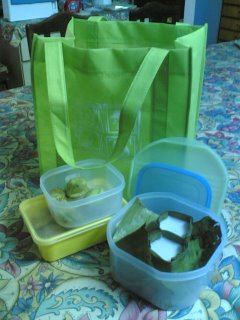 I did this when I shop for food especially here. I said here because I tense to forget sometimes when I did food-shopping elsewhere. I know that this is not good. I still have to set my mind to practice this no matter where I shop. That’s why I will normally have plastic boxes ready in my 4wd no matter where I go, whether far or near. In case I have to pack some food, I already have some containers ready in hand. People around me would be very surprised when I brought plastic containers to pack food that I bought. The pic on the right shown the kuih-muih I bought in the evening for break fast. So did you realize something here people. I could save our environment. In fact the plastic containers were so convenient that I could just place them on our dining table, ready to be served. It’s also with plastic cover, to avoid from the food being aired or attacked by insects etc.
We must change our attitudes towards waste disposal and recycling. The next time before you discard litter into the bin, look at what you hold in your hands. They are most likely to be made of paper, plastic, glass, metal or organic waste which are all recyclable one way or another. Yes, I agree with many that sometimes it is just too difficult to recycle when facilities such as recycling bins are scarce and few to come by. A lot more can be done by the government to promote recycling as a direct and effective method of reducing waste going to landfills.
What you can do to reduce use of plastic:
• Bring a nylon or cloth bag when you go shopping to save the use of plastic bags.
• Recycle plastic bags by taking along plastic bags from home when going shopping rather then using new plastic bags.
• Choose paper bags if you have an option to choose between paper bags or plastic bags.
• Composting is an efficient and environmentally friendly way of discarding home bulk waste which accounts for large proportion of household waste.
• An alternative is to use pots to compost if you don’t have a big garden. Get ten pots. Start by filling one pot with alternate layers of soil and household waste. Depending on family size, estimate three days per pot. Keep it moist. By the end of the month, the first pot will be ready for use in the garden or to store. Start the process again in the first pot.
Recycle everything you can; newspaper, cans, glass, aluminum foil and pans, motor oil, crap metal, etc. Click here to find out more about the 101 things you can do to conserve resources and protect the environment.
1. Insufficient rubbish bins that encourage us to separate our garbage; maybe this should be compulsory in office complexes and shopping complexes.
2. Not all schools have separate garbage bins for different types of rubbish, and therefore recycling is not taught from young.
3. An attitude change has not taken place – we definitely need a mindset shift to do this. We need to achieve critical mass on communication on recycling from all fronts; from the media, government councils, community centers, recycling centers, companies and businesses.
Recycling should be lead by large companies’ i.e. multinational companies that have experience overseas on recycling. For example, UK based supermarkets charge a small amount to customers for plastic bags they use when they make purchases. With this in mind, a lot of customers actually bring their own shopping bags to and place their purchases in the bags that they brought. Can such MNCs take on educating the public as a corporate responsibility to the community?? Which is the first hyper market that dares to charge customers for plastic bags first? Maybe, give them a few cents discount for plastic bags not used may be an idea.
.jpg) I did this when I shop for food especially here. I said here because I tense to forget sometimes when I did food-shopping elsewhere. I know that this is not good. I still have to set my mind to practice this no matter where I shop. That’s why I will normally have plastic boxes ready in my 4wd no matter where I go, whether far or near. In case I have to pack some food, I already have some containers ready in hand. People around me would be very surprised when I brought plastic containers to pack food that I bought. The pic on the right shown the kuih-muih I bought in the evening for break fast. So did you realize something here people. I could save our environment. In fact the plastic containers were so convenient that I could just place them on our dining table, ready to be served. It’s also with plastic cover, to avoid from the food being aired or attacked by insects etc.
I did this when I shop for food especially here. I said here because I tense to forget sometimes when I did food-shopping elsewhere. I know that this is not good. I still have to set my mind to practice this no matter where I shop. That’s why I will normally have plastic boxes ready in my 4wd no matter where I go, whether far or near. In case I have to pack some food, I already have some containers ready in hand. People around me would be very surprised when I brought plastic containers to pack food that I bought. The pic on the right shown the kuih-muih I bought in the evening for break fast. So did you realize something here people. I could save our environment. In fact the plastic containers were so convenient that I could just place them on our dining table, ready to be served. It’s also with plastic cover, to avoid from the food being aired or attacked by insects etc.We must change our attitudes towards waste disposal and recycling. The next time before you discard litter into the bin, look at what you hold in your hands. They are most likely to be made of paper, plastic, glass, metal or organic waste which are all recyclable one way or another. Yes, I agree with many that sometimes it is just too difficult to recycle when facilities such as recycling bins are scarce and few to come by. A lot more can be done by the government to promote recycling as a direct and effective method of reducing waste going to landfills.
What you can do to reduce use of plastic:
• Bring a nylon or cloth bag when you go shopping to save the use of plastic bags.
• Recycle plastic bags by taking along plastic bags from home when going shopping rather then using new plastic bags.
• Choose paper bags if you have an option to choose between paper bags or plastic bags.
• Composting is an efficient and environmentally friendly way of discarding home bulk waste which accounts for large proportion of household waste.
• An alternative is to use pots to compost if you don’t have a big garden. Get ten pots. Start by filling one pot with alternate layers of soil and household waste. Depending on family size, estimate three days per pot. Keep it moist. By the end of the month, the first pot will be ready for use in the garden or to store. Start the process again in the first pot.
Recycle everything you can; newspaper, cans, glass, aluminum foil and pans, motor oil, crap metal, etc. Click here to find out more about the 101 things you can do to conserve resources and protect the environment.
kuE's note: The green "I Care" bag was a courtesy of Cold Storage, Gurney Plaza.
Tuesday, September 26, 2006
Anonymous Online
Having internet in our modern life has turned out to be a necessity. Thousands of computer user groups has been created and grew into huge virtual communities. Each internet user, at least once in their lifetime must have created a user account in one of the websites visited. Be it for browsing catalogues, creating a free web mail account, downloading or sharing files, participate in online auctions and thousands of other reasons that required us to register.
Whenever I came across the buttons labelled Sign Up or Register Now! I've always asked myself, should I key in my personal data here? Yes, I know now so many of the pages have already put up disclaimers saying that any particulars keyed into the forms will not be misused. Well, I'm Dayang... I always have doubts.
If you have this same feeling and not comfortable filling in the details, the good news is, you don't have to. It's quite a difficult thing to do, but trust me, you don't have to oblige to everything the webpage tells you. In other words, it's okay to remain anyonymous online.
In my case however, I can't remain 100% anonymous in the virtual world as my career revolves around it. There are certain times at certain webpages where I have to be the real me.
But if you are nothing like me, or not doing the stuffs I do, for example I have to download certain patches every six month from principal's website and must get daily update on latest operating system security threat, then by all means you can stay as 'ANON' for as long as you live!
How would you know that you'd rather be an 'ANON' or your true self online? My suggestion is to go to any of the search engines e.g google, yahoo or MSN, then type in your full name. See all the results returned and how do you feel about them? There's a high chance that you'd find some real information related to you there. If it scared you till you face turns blue, you should become an 'ANON'.
My bitter experience was I saw my whole personal detail including my IC number, place of birth, home town and home address returned by the search engine. It so happened that my uni has published students' data in one of the facultys' website in 1997. The main page now doesn't have a link to the pages anymore but the files are still in the webserver. Obviously the search engines managed to crawl and grab the contents even though the pages are inactive.
Imagine what happened to all the data we keyed-in in all those online registration forms. How do we know where they'd be stored? Who'll get their hands on them (both virtually and physically)? How sure are we that they're not being traded? What other systems are interfaced with that website we registered at that might be pumping those information out to be manipulated by other parties?
There were just too many questions I had in mind whenever I came across that Sign Up button that most of the times I just stopped at that page, and dropped the idea of downloading the song/movie/file/installer. Well, I'm Dayang, I get discouraged easily...
So, there goes the first installment. Coming up soon: How to become anonymous.
Author's Note: I'm Dayang... I write about IT stuff *Yawn*
Whenever I came across the buttons labelled Sign Up or Register Now! I've always asked myself, should I key in my personal data here? Yes, I know now so many of the pages have already put up disclaimers saying that any particulars keyed into the forms will not be misused. Well, I'm Dayang... I always have doubts.
If you have this same feeling and not comfortable filling in the details, the good news is, you don't have to. It's quite a difficult thing to do, but trust me, you don't have to oblige to everything the webpage tells you. In other words, it's okay to remain anyonymous online.
In my case however, I can't remain 100% anonymous in the virtual world as my career revolves around it. There are certain times at certain webpages where I have to be the real me.
But if you are nothing like me, or not doing the stuffs I do, for example I have to download certain patches every six month from principal's website and must get daily update on latest operating system security threat, then by all means you can stay as 'ANON' for as long as you live!
How would you know that you'd rather be an 'ANON' or your true self online? My suggestion is to go to any of the search engines e.g google, yahoo or MSN, then type in your full name. See all the results returned and how do you feel about them? There's a high chance that you'd find some real information related to you there. If it scared you till you face turns blue, you should become an 'ANON'.
My bitter experience was I saw my whole personal detail including my IC number, place of birth, home town and home address returned by the search engine. It so happened that my uni has published students' data in one of the facultys' website in 1997. The main page now doesn't have a link to the pages anymore but the files are still in the webserver. Obviously the search engines managed to crawl and grab the contents even though the pages are inactive.
Imagine what happened to all the data we keyed-in in all those online registration forms. How do we know where they'd be stored? Who'll get their hands on them (both virtually and physically)? How sure are we that they're not being traded? What other systems are interfaced with that website we registered at that might be pumping those information out to be manipulated by other parties?
There were just too many questions I had in mind whenever I came across that Sign Up button that most of the times I just stopped at that page, and dropped the idea of downloading the song/movie/file/installer. Well, I'm Dayang, I get discouraged easily...
So, there goes the first installment. Coming up soon: How to become anonymous.
Author's Note: I'm Dayang... I write about IT stuff *Yawn*
Sunday, September 24, 2006
How to teach your toddler to do chores

Assigning chores to your toddler might well seem like a chore in itself. After all, a 2-year-old isn't going to be the neatest or most efficient worker. But giving your toddler even the tiniest measure of responsibility now will pay off later by laying the groundwork for future good habits. Plus, having a chore to do makes your child feel like part of the family, someone whose contribution is valued. When assigning chores, keep these pointers in mind:
Pick tasks that are appropriate to your child's age.
Be sure to choose simple, straightforward jobs, since your toddler simply doesn't have the cognitive ability yet to break down a large project into its components. Tell him to go clean his room, for instance, and you're likely to be met with a blank stare. But he could be responsible for one part of the job, such as putting his clothes in the laundry basket or helping you pick up all his toys. And define chores loosely: putting his bowl and spoon on the table before dinner could constitute a chore, as could putting his toothbrush back in the holder.
Toddlers want to be just like Mom and Dad, so capitalize on your power as a role model and let your child work alongside you as an assistant. Hand him a sponge while you're cleaning the kitchen and let him wipe off the table. You'll find him quite willing -- even thrilled -- to be called on to help.
Keep instructions low-key.
Before your child takes on a chore, demonstrate it for him, talking it through as you go. For example, you might show him how you sort light and dark clothing into different piles before you wash it. Remember, at this age, chores shouldn't be so complicated that they require a lengthy explanation. Anything that takes more than a minute to explain is probably too difficult for your toddler to do anyway.
Stand back.
When your toddler first tries a task on his own, be patient. Jumping in too quickly to lend a hand gives him the message that you don't think he's capable. And never belittle his efforts. If you want to offer a suggestion, do it kindly: Instead of saying "No, that's not right," try "You're doing a great job sorting laundry. I like to put the brown socks in with dark clothes, though, since they're a darker color."
Make helping a habit.
Get everyone into a routine by doing chores at about the same time every day. For instance, your toddler's jobs might be to put his pajamas away in the morning and pick up his toys every evening before bed. You also might try designating a particular day of the week as cleaning day and giving your toddler a bigger job, such as helping with dusting or sweeping.
It helps to post a list of household chores and who has to do them. This way your child learns that everyone in the family contributes to the smooth running of the household. Since your child won't be reading for a few years yet, look for a ready-made chore chart that uses symbols instead of words to represent chores (a broom for sweeping, a dish and dishtowel for dishwashing). A star or sticker next to a completed chore is an ample reward, along with plenty of praise for a job well done. And remember to adjust your child's chores as he grows.
Whistle while you work.
Getting to spend more time with you is one of the biggest incentives for your child to do chores, so don't send him off to work alone until he's older and more experienced. Even if his job is to pick up the Legos in his room, stay nearby and chat with him, or join in with your own task. He'll appreciate your company, and you can encourage him if he loses his focus. Make his job easier by providing easy, accessible storage for his playthings such as clear plastic bins for toys.
Chances are your child will think a job like sweeping is actually fun -- especially if he has his own child-size broom and dust pan. So if you happen to view housekeeping as drudgery, don't let on. Make it a race ("Let's see who can get their toys into the box first") or sing silly songs together.
Be sure to tell your child what a great job he's doing and remind him how much he's helping you out. You can also point out the benefits of his work; if he's helping you wipe the kitchen table, you might say something like "Now it will be clean when we sit down for dinner." This gives him a sense of accomplishment and shows him just how significant his contributions are.
Don't expect perfection.
No child is going to perform every chore willingly every time -- and certainly not a 2- or 3-year-old! Just like grownups, kids have other things they'd rather do besides housework. If you need to issue a reminder, try to be friendly and matter-of-fact. Nagging almost never works. Instead, simply say, "It's time to put away your toys. Then we can read your bedtime story." Part of the purpose of having chores is to develop a sense of initiative in your child, so try not to micro-manage. Recognize that the task won't be done perfectly at this age -- and it doesn't need to be.
And above all, keep in mind that your child has a long, long time to learn to do chores. If it takes a few months for him to get in the hang of helping out, that's okay. It's a skill he can use for the rest of his life.
kuE's note:
i) I find this article rather interesting to share with other parents out there. I did similar to my kids too. Alhamdulillah... they did well ;)
ii) I also would like to take this opportunity to wish all muslims no matter where ever you are, Selamat Berpuasa and enjoy Ramadhan with your loved ones.
Subscribe to:
Posts (Atom)